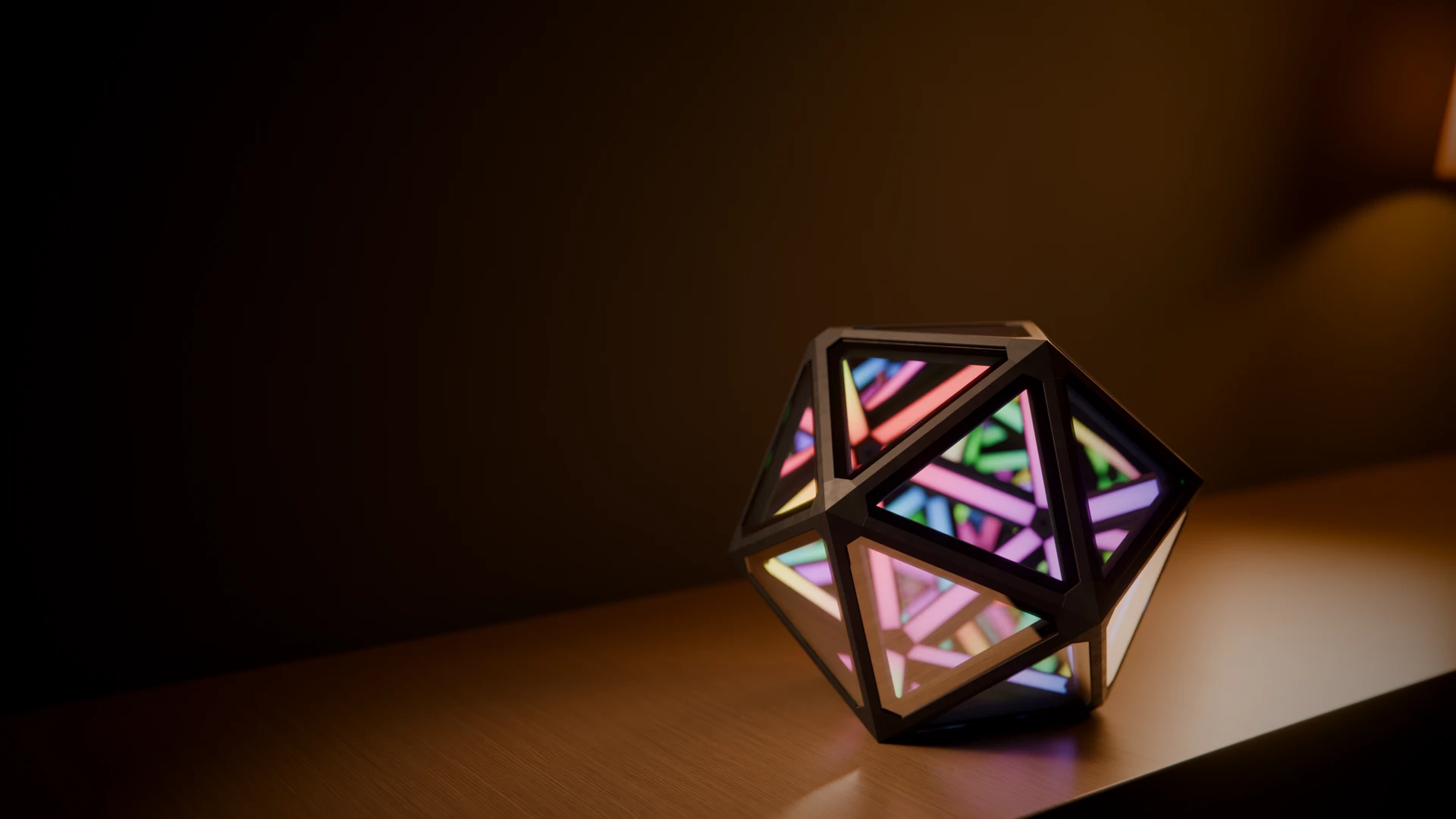


DIY Kit
Every part cut and ready, the controller pre-flashed, and a step-by-step guide. Built in an evening.
Pre-launch: be first to know
A 29 cm LED infinity-mirror lamp: twenty mirrored faces and thirty lines of light. It is coming as a DIY kit, as printable files, and as a finished lamp.
The DIY Kit: WLED preinstalled power supply included some soldering about an evening
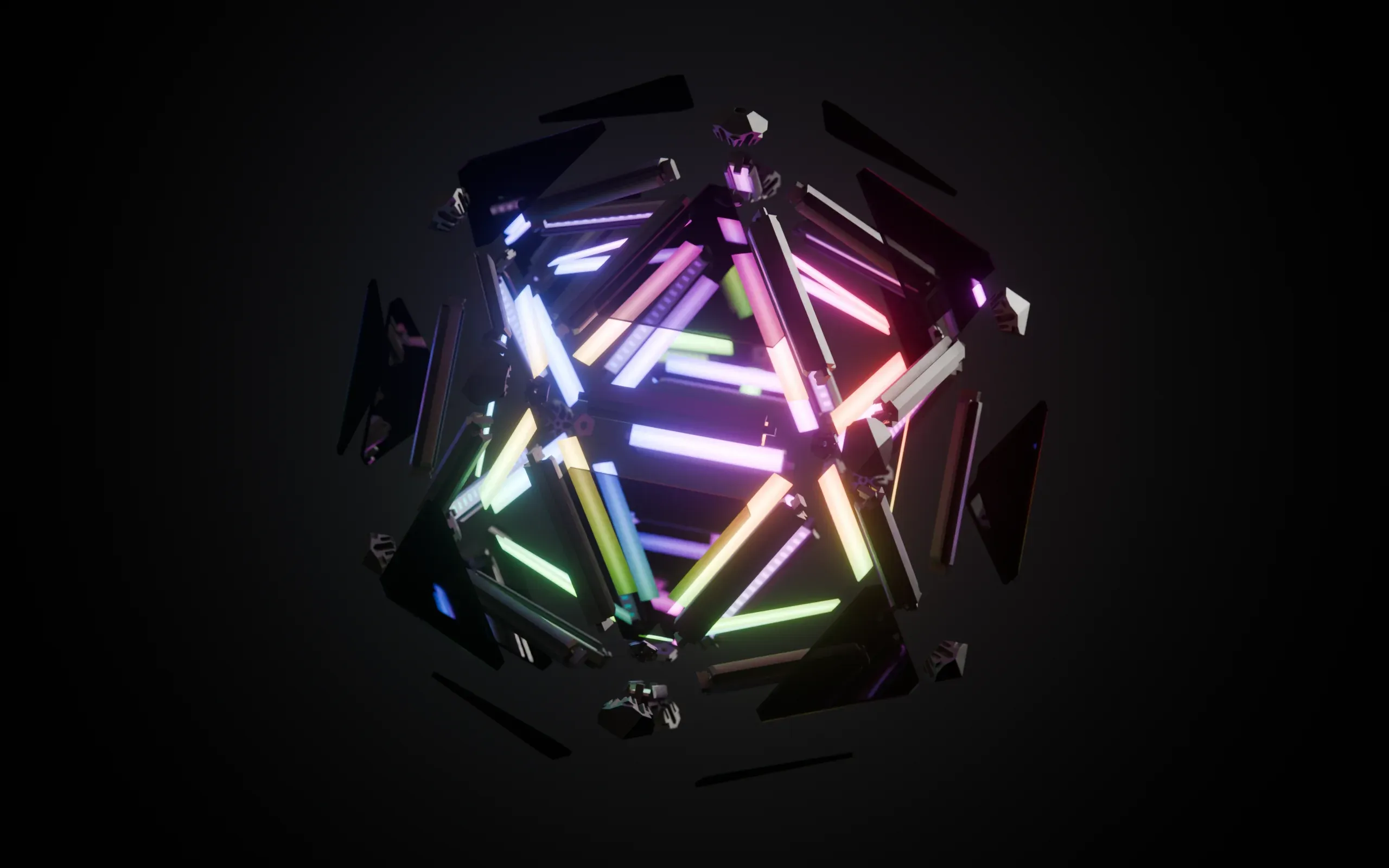
An ESP32 running WLED drives every LED, from the app, Home Assistant, or your music with an optional microphone.

12 corners
Five rails meet in each hub, located by detents and a ridge-in-notch lock. A clamp plate and one screw into a brass threaded insert hold them together, so the frame stays true and can come apart again.

30 edges
Each rail hides its LEDs in a deep channel behind a slide-in frosted diffuser. With the Dense option, 15 LEDs per edge read as one continuous line of light.

20 faces
Acrylic panels set with clear VHB glazing tape. Light bounces between the mirrored faces, and the tunnels run back as far as you can see.
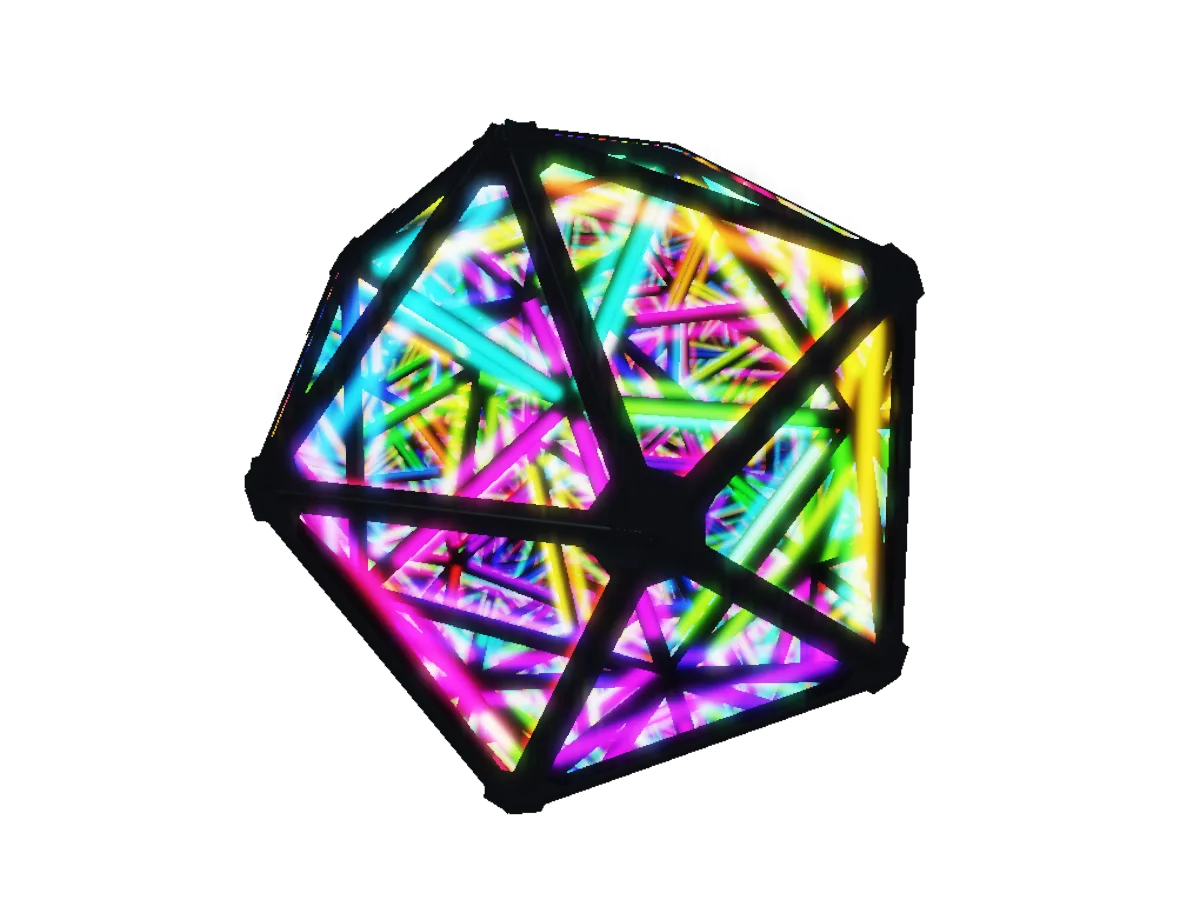
Rainbow Flow
Any colour, any mood. This is the lamp ray-traced: its 450 full-colour LEDs placed from the CAD model, reflecting between twenty one-way mirrors.
A simulation, not a recording: colour, glow and mirror depth are approximate.
The hubs set every angle, so the frame closes true. Lay in the LEDs, slide on the diffusers, test the light, then set the mirrors. Plan on an evening; some soldering is needed.
The ESP32 arrives with WLED installed. Join it to your Wi-Fi and pick from more than a hundred effects in the free WLED app or any browser. No account, no cloud.
Home Assistant finds WLED on your network, so the lamp joins your scenes and automations. Add the optional microphone and the edges move with your music.
c. 360 BC
In Plato's Timaeus, each classical element is built from one regular solid: earth the cube, air the octahedron, fire the tetrahedron, and water the icosahedron, the most round of them. Plato suggested this was why water flows and slips through your fingers.
1 of 5
It is one of just five Platonic solids, where every face, edge and corner is identical: 20 equilateral triangles, 30 edges and 12 corners, five triangles meeting at each. It has the most faces of the five. Euclid's Elements (Book XIII, c. 300 BC) closes with how to construct all five.
20
Twenty-sided dice inscribed with Greek letters survive from Ptolemaic and Roman Egypt, about 2,000 years ago, including one at the Metropolitan Museum of Art. The Met notes they were most likely used for divination: an ancient oracle book describes throwing lots to reach a prepared answer from the gods.
1509
Leonardo da Vinci drew the icosahedron for Luca Pacioli's De divina proportione ("On the Divine Proportion"), printed in Venice in 1509. Pacioli pointed out that three golden rectangles fit perfectly inside it.
1.618
The twelve corners sit exactly on three interlocking golden rectangles, with sides in the ratio 1 : 1.618. Our lamp is designed around these coordinates: the hubs sit at (0, ±1, ±φ) and its cyclic permutations, scaled to size.
1962
Many viruses build their protective shells, called capsids, with icosahedral symmetry: the most efficient way to enclose a space from many identical pieces. Donald Caspar and Aaron Klug explained this in 1962, inspired by Buckminster Fuller's geodesic domes.
20th c.
Buckminster Fuller built his geodesic domes by subdividing the icosahedron. His Dymaxion world map unfolds the Earth onto one, with far less distortion than a flat map.
Today
In modern sacred-geometry traditions, the icosahedron is associated with water, and with flow, change and emotional depth. Now you can build one.
Specifications reflect the current design and may be refined before launch.

If you can follow a recipe and you are comfortable with a little soldering, you can build this. The hubs set every angle, so there is no measuring or guesswork. First-time solderers will want to practise a few joints on a spare piece of strip first.
A screwdriver and a soldering iron. The iron sets the brass threaded inserts into the hubs and joins the LED strip between edges. Solder, flush cutters and a wire stripper make the job easier. Everything else is in the box.
Plan on an evening. Your first time through the guide will take a little longer than the next, and it is worth going slowly on the solder joints.
A 5 V plug-in power supply is included, sized for the LED option you choose. WLED's built-in current limiter is set to match, so the lamp stays within what the supply can safely deliver, even on full white.
Dense (144 LEDs per metre) gives smooth, continuous lines and the deepest-looking tunnels, which is why we recommend it. Standard (60 per metre) shows a dotted, pixel look and draws less power. Both work with every WLED effect.
No account. WLED runs on the lamp itself over your local Wi-Fi (2.4 GHz). Use the free WLED app for iOS or Android, or open the lamp's page in any browser. Home Assistant users can add it with the built-in WLED integration.
Yes, with WLED's sound-reactive effects. They need a sound source: a small microphone wired to the controller, or audio sent over your network from another device. We will confirm at launch exactly what the kit includes for this.
Both use a mount hub: a corner hub with a 1/4"-20 threaded insert, so the lamp can hang or sit on a stand. They are planned accessories, and full details come at launch.
Nothing is on sale yet. Join the list and we will email you when the DIY Kit is ready. Shipping, returns and warranty details will be published before then.
Both are in the works and we have not set dates yet. Tick them when you join the list and we will email you when they are ready, and not before.
Sources for the history chapter.
One email when it's ready, and a note as each version arrives: the DIY Kit, the printable files and the finished lamp. Nothing else, and you can leave any time.
Every part cut and ready, the controller pre-flashed, and a step-by-step guide. Built in an evening.
STEP and STL files plus the full build guide, for makers with their own 3D printer.
Assembled, tested and ready to plug in. The same lamp, without the build.